Choose magnesium tailored to your goal. A complete guide to Magnesium forms from Skill.
09.04.2026Table of contents
- 1.Why does the form of magnesium matter?
- 2.1. Magnesium Malate – energy for a strong start to the day
- 3.2. Magnesium Citrate – when fatigue and lack of focus kick in
- 4.3. Magtein® (Magnesium L-threonate) – support for mental performance and focus
- 5.4. Magnesium Bisglycinate – support for evening recovery
- 6.How to choose the right magnesium for your goal and needs?
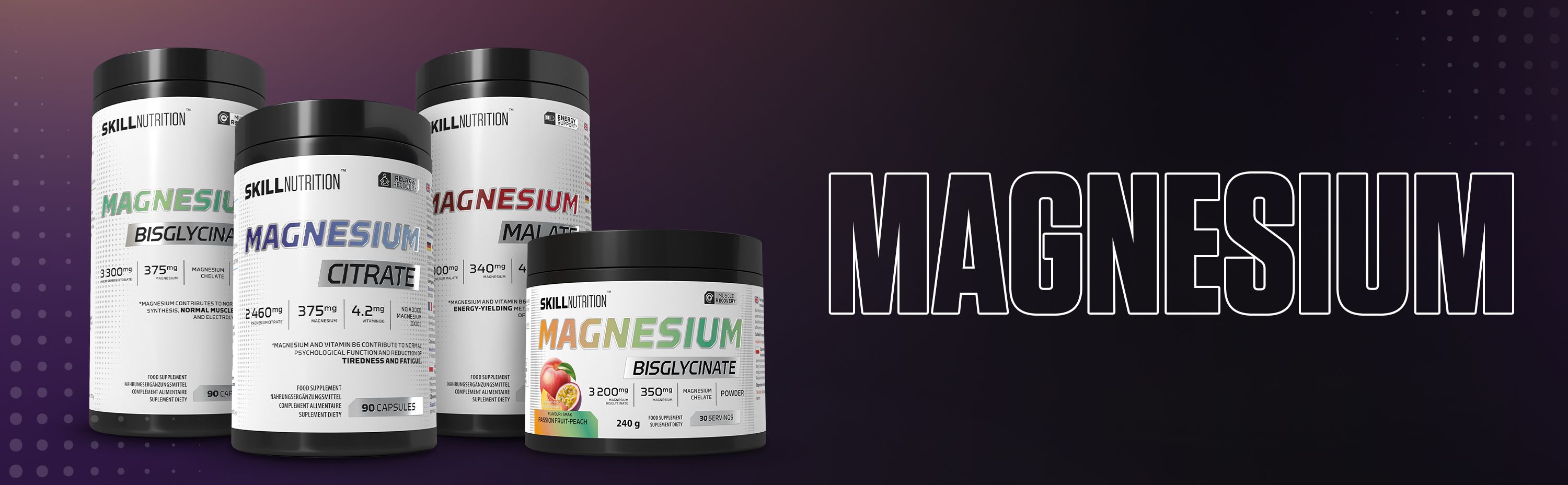
Morning lack of energy, drops in concentration during the day, or evening tension and difficulty unwinding are all signals that your body needs proper support. Magnesium contributes to the normal functioning of these areas - provided you choose the right form. At Skill Nutrition, we focus on different types of this dietary supplement, tailored to specific needs, daily rhythms, and lifestyles. See which one best aligns with your goal.
Why does the form of magnesium matter?
Although each is simply labeled as “magnesium,” the differences between individual forms are significant in practice. The chemical compound in which magnesium appears determines how quickly it is absorbed, where it works most effectively in the body, and which processes it supports.
Some forms better support energy production, others the nervous system and concentration, while still others help you relax and recover after an intense day. They also differ in terms of digestive tolerance and bioavailability - how much actually reaches your cells. That’s why, instead of choosing “just any magnesium,” it’s worth selecting one that matches your lifestyle, time of day, and the goal you want to achieve.
1. Magnesium Malate – energy for a strong start to the day
There are mornings when the alarm goes off, your coffee gets cold, and your body is still mentally under the covers. In moments like these, Magnesium Malate works particularly well - a form often chosen by those looking to support energy metabolism. The combination of magnesium and malic acid supports metabolic pathways responsible for ATP production - the “chemical fuel” essential for proper muscle function and nerve conduction. [1]
This is magnesium for a good start. It helps reduce morning fatigue, supports normal muscle and nervous system function, and - thanks to the presence of active vitamin B6 - also supports concentration. [2] That’s why malate fits perfectly into the daily rhythm of people who live intensively, train, work mentally, or simply want to start their day with more internal energyn- not just another cup of coffee.
2. Magnesium Citrate – when fatigue and lack of focus kick in
Sometimes, despite having a clear plan and motivation, your body signals fatigue - concentration drops, thoughts become harder to manage, and tiredness appears surprisingly quickly. In such moments, it’s worth reaching for a form of magnesium that is versatile and quickly absorbed: citrate.
Magnesium Citrate from Skill combines a well-absorbed organic form of magnesium with vitamin B6 in its active form. Both ingredients contribute to normal energy metabolism and help reduce tiredness and fatigue. They also support the proper functioning of the nervous system and psychological functions, which is especially important when you need mental clarity and better focus during the day. [2]
3. Magtein® (Magnesium L-threonate) – support for mental performance and focus
When your day is filled with meetings, data analysis, studying, or long hours in front of a screen, your body’s needs clearly shift. At such times, the priority is not just “raw” physical energy, but efficient nervous system function and cognitive comfort. This is exactly what Magtein® was designed for - a modern, patented form of magnesium L-threonate.
This form of magnesium has been studied for its potential to support nervous system function and psychological processes such as concentration. [3] That’s why Magtein® is particularly interesting for people engaged in intensive mental work, studying, or preparing for exams.
However, it’s worth remembering that a well-functioning nervous system is important beyond desk work. Magnesium also supports normal muscle function, helps maintain electrolyte balance, and contributes to reducing tiredness and fatigue. This makes Magtein® a valuable option during periods of intense training or competition, when focus, coordination, and fast nervous system recovery play a key role. [4]
4. Magnesium Bisglycinate – support for evening recovery
After a full day of stimuli, screens, workouts, and responsibilities, your body needs a signal that it can slow down. This is the moment when a form of magnesium focused not on activation, but on calming and replenishment, becomes especially valuable. Magnesium bisglycinate is a chelate - a stable combination of magnesium with the amino acid glycine - known for its high bioavailability and excellent digestive tolerance. [5]
Magnesium contributes to the normal functioning of the nervous system and muscles, supports electrolyte balance, and helps reduce tiredness and fatigue. In practice, this means better conditions for overnight recovery and gradual relaxation before sleep. [4]
Magnesium Bisglycinate from Skill is available both in tablet form and as an easily dissolvable powder. It’s a great option for those who want to properly wind down their day, support the nervous system and muscles, and ensure optimal recovery.
How to choose the right magnesium for your goal and needs?
Choosing the right form of magnesium should be based on which processes you want to support at a given time - energy production, nervous system function, cognitive performance, or muscle recovery. Although each form provides the same mineral, they differ in bioavailability and how the body utilizes them.
This means that instead of choosing magnesium “blindly,” you can select a form that best matches your lifestyle, daily rhythm, and current challenges.
Sources:
- Barbagallo M, Veronese N, Dominguez LJ. Magnesium-An Ion with Multiple Invaluable Actions, Often Insufficiently Supplied: From In Vitro to Clinical Research. Nutrients. 2023 Jul 13;15(14):3135. doi: 10.3390/nu15143135. PMID: 37513553; PMCID: PMC10385004.
- Pouteau E, Kabir-Ahmadi M, Noah L, Mazur A, Dye L, Hellhammer J, Pickering G, Dubray C. Superiority of magnesium and vitamin B6 over magnesium alone on severe stress in healthy adults with low magnesemia: A randomized, single-blind clinical trial. PLoS One. 2018 Dec 18;13(12):e0208454. doi: 10.1371/journal.pone.0208454. PMID: 30562392; PMCID: PMC6298677.
- Zhang C, Hu Q, Li S, Dai F, Qian W, Hewlings S, Yan T, Wang Y. A Magtein®, Magnesium L-Threonate, -Based Formula Improves Brain Cognitive Functions in Healthy Chinese Adults. Nutrients. 2022 Dec 8;14(24):5235. doi: 10.3390/nu14245235. PMID: 36558392; PMCID: PMC9786204.
- Nielsen FH, Lukaski HC. Update on the relationship between magnesium and exercise. Magnes Res. 2006 Sep;19(3):180-9. PMID: 17172008.
- Schuette SA, Lashner BA, Janghorbani M. Bioavailability of magnesium diglycinate vs magnesium oxide in patients with ileal resection. JPEN J Parenter Enteral Nutr. 1994 Sep-Oct;18(5):430-5. doi: 10.1177/0148607194018005430. PMID: 7815675.
Table of contents
- 1.Why does the form of magnesium matter?
- 2.1. Magnesium Malate – energy for a strong start to the day
- 3.2. Magnesium Citrate – when fatigue and lack of focus kick in
- 4.3. Magtein® (Magnesium L-threonate) – support for mental performance and focus
- 5.4. Magnesium Bisglycinate – support for evening recovery
- 6.How to choose the right magnesium for your goal and needs?